Why Virtual Education Is No Longer Optional: The Gateway to Global Competence
By Dr. Marisol Marcin, Founder & CEO of Lenguas Club
Part 3 of the Portrait of a Graduate Series
______________________________________________________________________________
There is a shift happening in how businesses define “qualified.” Degrees still matter. Test scores still count. But increasingly, the question employers are asking is not just what candidates know or where they studied. The question is whether they can work effectively with people who see the world differently than they do.
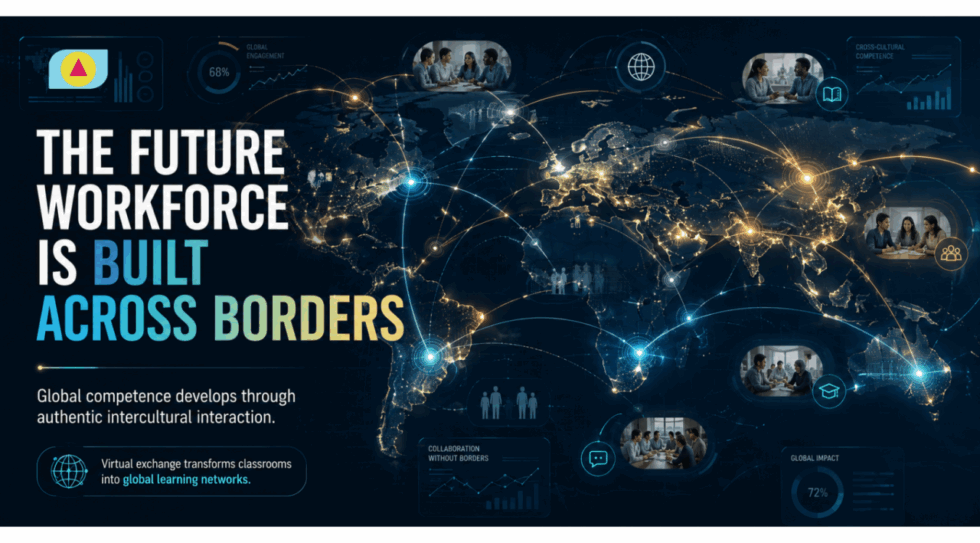
The global workforce is no longer an aspiration. It is the default. By 2026, most mid-sized and large organizations are hiring across borders as a standard practice, not an exception. Remote work normalized what was once rare: teams distributed across continents, time zones, and cultures, collaborating daily on projects that require them to navigate not just technical complexity but human difference.
In this environment, cultural intelligence is not a soft skill. It is a survival skill. And the educational systems that prepare students to develop it will produce graduates who thrive in the economy that is already here. The systems that do not will produce graduates who struggle to keep pace.
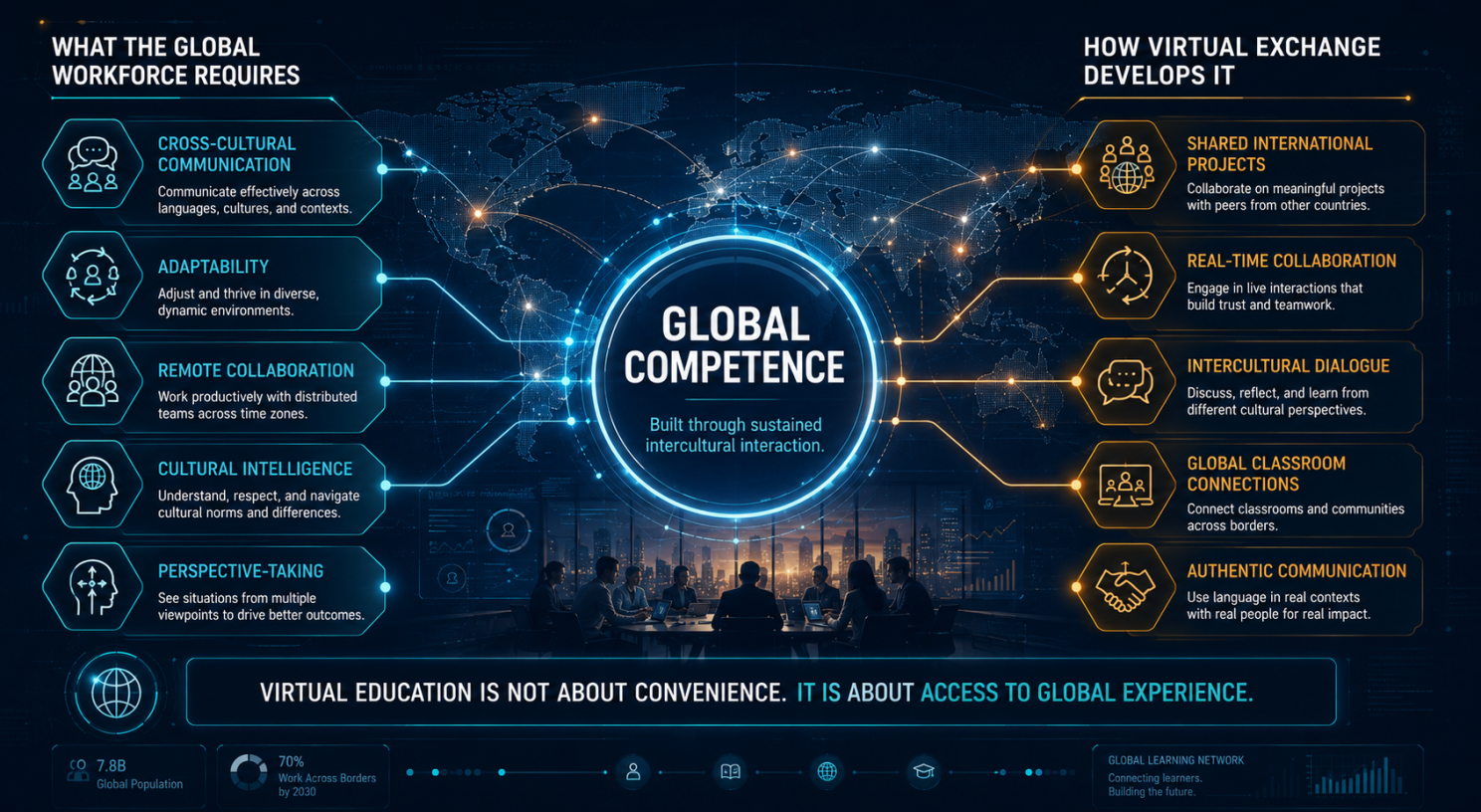
Virtual education is not about convenience. It is about access to the experiences that build the capacities the modern world demands.
______________________________________________________________________________
The Case for Inevitability: Why Virtual Education Is Here to Stay
The question is no longer whether online learning works. According to Coursmos (2024), as reported by George Altawil in “Is Online Learning Here to Stay? Trends & Insights for 2026” published by California Miramar University in November 2025, there were approximately 73.8 million online learners globally in 2024, representing a nearly 900% increase since 2000. The global e-learning market is expected to reach $400 billion by 2026. In the United States, more than half of higher education institutions report that enrollment in online programs is outpacing on-campus growth.
These are not experimental programs. These are degree-granting institutions, professional development platforms, and K-12 school systems that have concluded that virtual education is not a temporary adaptation but a permanent infrastructure.
The reasons are practical:
- Access: Students who cannot relocate, travel, or attend in-person classes can still participate in rigorous learning experiences.
- Efficiency: According to Devlin Peck (2024), as cited in the same California Miramar University report, retention rates for online learners can reach up to 60%, compared to 8-10% in traditional face-to-face classrooms, and students report saving 40-60% of study time when learning online.
- Scalability: Virtual programs can serve learners across regions, states, and countries without duplicating physical infrastructure.
- Flexibility: According to News.com.au (2024), 84% of learners prefer online learning because of the ability to learn at their own pace, and 81% report that online learning helps improve their grades.
But those are not the most important reasons virtual education has become inevitable.
The most important reason is that virtual environments create opportunities for the kinds of human interactions that prepare students for the world they will actually enter after graduation: a world where most meaningful work happens across geographic and cultural boundaries.
______________________________________________________________________________
Virtual Exchange: The Gateway to Multicultural Competence
Virtual exchange refers to structured programs where students from different countries, regions, or cultural backgrounds collaborate online through video calls, shared projects, and facilitated discussion. These are not passive interactions. They are intentional learning experiences where students work together on tasks that require them to communicate across difference, negotiate meaning, and co-construct understanding in real time.
The evidence on virtual exchange is clear. The 2024 AFS Global You Virtual Exchange Impact Study by AFS Intercultural Programs found that virtual exchange programs have a meaningful immediate impact on the development of global competence among high school-aged youth. Participants demonstrated significant gains in three specific areas:
- Having a more positive view of peers from other cultures
- Being able to actively withhold judgment of others
- Improved cross-cultural communication skills
Research from the Stevens Initiative, which has supported virtual exchange programs across thousands of classrooms since 2015, reinforces these findings. In an evaluation of Stevens Initiative-supported programs documented in their 2024-2025 Global Champions report, 89% of participants reported increases in their job skills as a result of participating in virtual exchange. Additionally, 77% of participants reported having more confidence in their ability to have an impact in their home country.
These are not vague benefits. These are measurable competencies that align directly with what employers, universities, and civic organizations say they need from the next generation of workers and citizens.
______________________________________________________________________________
Language Is Not Enough: The Cultural and Geospatial Dimensions of Global Competence
One of the most persistent misconceptions about preparing students for a global workforce is that learning a language is sufficient. It is not.
Language is essential. It is the vehicle for communication. But communication is not the same thing as understanding. A student can learn Spanish grammar, memorize vocabulary, and practice pronunciation with an app. But none of that prepares them to navigate the moment when they realize that “yes” in one culture means “I agree,” and in another culture it means “I heard you, but I’m not committing.”
Cultural competence requires students to understand that meaning is not universal. It is shaped by geography, history, values, communication norms, and relationships. A direct communication style that feels honest and efficient in one context can feel aggressive or disrespectful in another. A hierarchical decision-making process that feels orderly in one culture can feel exclusionary in another. The ability to read those differences, adapt communication in real time, and build trust across them is not something students learn from textbooks. It is something they learn from experience.
Virtual exchange provides that experience. When students collaborate with peers from other countries on a shared project, they encounter the friction that comes from difference. They discover that their assumptions about how meetings should run, how feedback should be given, or how disagreements should be resolved are not universal. And they learn to navigate that friction without walking away.
That is the work that prepares them for the economy they are entering.
______________________________________________________________________________
The Global Workforce Is Already Here
The shift to a distributed, geographically flexible workforce is not a future trend. It is the present reality. In an article published on LinkedIn in November 2025 by Solomon Amar analyzing five global workforce trends for 2026, companies expect hiring across borders to be one of the major workplace trends. The analysis identified global teams as “the default, not the exception,” with companies hiring wherever the strongest talent can be found, regardless of location.
This shift changes what employers value. In an article titled “How Cultural Intelligence Predicts Your 2026 Success” published by Tough Convos in December 2025, cultural intelligence is identified as a meta-skill that predicts professional performance in 2026 and beyond. Leaders with high cultural intelligence can:
- Lead remote or AI-augmented teams with clarity, managing time zones, communication norms, and cultural rhythms so teams stay aligned
- Give feedback that lands, tailoring tone and directness to cultural expectations
- Build trust and retention, creating environments where people from different backgrounds feel heard and valued
- Ignite innovation, leveraging diverse perspectives as a strength rather than a source of confusion
According to Taggd’s “Intercultural Competence: Key to Global Careers in 2025” published in July 2025, companies with high-CQ leaders see measurable gains in retention, engagement, collaboration, and trust.
But cultural intelligence is not something that can be taught in a workshop. It must be developed through sustained interaction with people from different cultures over time. That is why virtual exchange matters. It creates the conditions for students to practice the skills employers will expect them to have on day one.
______________________________________________________________________________
Where Virtual Education Aligns with The Portrait of a Graduate
Every Portrait of a Graduate framework across the country names the same core attributes: critical thinking, effective communication, collaboration, global citizenship, and adaptability. Virtual exchange programs develop all of them simultaneously.
When students participate in virtual exchange, they:
- Think critically about their own assumptions and the assumptions of others
- Communicate effectively across differences in language, culture, and communication style
- Collaborate with peers who approach problems differently than they do
- Develop global citizenship by building relationships with people from other countries and learning to see the world from perspectives beyond their own
- Practice adaptability by navigating the friction that comes from working with people whose norms, values, and expectations differ from theirs
These are not separate competencies. They are interdependent capacities that students develop through authentic interaction with people who challenge them to question what they think they know.
That is why virtual education is not an alternative to the Portrait of a Graduate. It is one of the clearest pathways to making the Portrait real.
______________________________________________________________________________
The Challenge of Implementation: What Schools Need to Know
Virtual exchange does not happen by accident. It requires infrastructure, training, and intentional design.
Schools that have successfully integrated virtual exchange into their programs report several key factors that contribute to success:
- Clear learning goals aligned with curriculum: Virtual exchange works best when it is integrated into existing courses rather than treated as an add-on. Teachers need to know how the exchange connects to the standards and competencies they are already teaching.
- Training for educators: Many teachers have not participated in virtual exchange themselves and may not know how to facilitate intercultural dialogue or manage the logistics of coordinating with partners in other time zones. Professional development is essential.
- Technology that works reliably: Virtual exchange depends on stable internet connections, video conferencing platforms, and collaboration tools. Schools need to ensure that students and teachers have access to the technology they need.
- Time zone flexibility: Coordinating live sessions between schools in different time zones requires creativity. Some programs use asynchronous components (recorded videos, shared documents) to reduce the scheduling burden.
- Sustained partnerships: One-time exchanges provide limited value. The programs that produce measurable gains in intercultural competence are those that unfold over multiple weeks, allowing students to build relationships and work through the awkwardness of early interactions.
The Stevens Initiative, which has supported hundreds of virtual exchange programs across K-12 and higher education since 2015, provides resources, training, and funding for schools that want to launch virtual exchange programs. Organizations like AFS Intercultural Programs, Soliya, and Class2Class offer ready-made platforms that connect classrooms across countries and provide facilitation support.
The barrier to entry is lower than most schools assume. What is required is not a large budget or a complex technology stack. What is required is a commitment to prioritizing the development of global competence as a non-negotiable outcome for students.
______________________________________________________________________________
Where Lenguas Club Fits in This Conversation
At Lenguas Club, we design world language programs that integrate the principles of virtual exchange into daily instruction. Our intercultural exchange programs connect students in New York with peers in Latin America for multi-week experiences where they engage in real communication through shared writing, audio, and video messages, collaborative tasks aligned with what they are learning in class, and live synchronous sessions.
These exchanges develop all three ACTFL communication modes—interpersonal, interpretive, and presentational—while building confidence, global awareness, and authentic communication skills. Students do not just learn about other cultures. They experience them, alongside peers who challenge them to think beyond their own perspectives.
We also support teachers through our Global Classroom Connections program, where educators are matched and supported to co-create meaningful exchanges between their students. These classroom-to-classroom connections foster real-world communication in Spanish, collaborative projects with global relevance, deeper cultural understanding, and development of global citizenship skills.
The work we do is not separate from the Portrait of a Graduate. It is an expression of it. Every program we design is built on the belief that students who practice authentic communication across cultural boundaries will graduate better prepared for the world they are entering—a world where cultural intelligence, adaptability, and the ability to collaborate across difference are not optional skills. They are essential ones.
If your district has a Portrait of a Graduate but is still figuring out how to integrate global competence into your curriculum, we would be glad to explore it with you. The work we do in world languages offers a model for what it looks like when virtual exchange becomes a regular part of the student experience, not an occasional enrichment activity.
______________________________________________________________________________
What would it look like if every student in your district had sustained, authentic interaction with peers from other countries before they graduated?
We would love to help you figure that out.
📞 607-682-2624
🌐 lenguasclub.com/contact/
🌐 info@lenguasclub.com
#PortraitOfAGraduate #VirtualExchange #GlobalCompetence #CulturalIntelligence #WorldLanguages #K12Education #FutureReadyStudents #InterculturalLearning #NYSchools
References
AACSB. (2024, October). How microcredentials are changing higher education. AACSB. https://www.aacsb.edu/insights/articles/2024/10/how-microcredentials-are-changing-higher-education
African Journal of International Relations (AJPOJOURNALS). (2025). Role of cultural diplomacy in strengthening soft power among emerging economies. https://ajpojournals.org/journals/AJIR/article/download/2464/3268/9305
AFS Intercultural Programs. (2024). AFS Global You Virtual Exchange Impact Study. https://afs.org/international/study-abroad/virtual-exchange/
Altawil, G. (2025, November 10). Is online learning here to stay? Trends & insights for 2026. California Miramar University. https://www.calmu.edu/is-online-learning-here-to-stay-trends-insights-for-2026
Amar, S. (2025, November 17). These are the 5 global workforce trends I believe will shape 2026. LinkedIn. https://www.linkedin.com/posts/solomonamar_these-are-the-5-global-workforce-trends-i-activity-7396489760267137026-wD5F
Class2Class. (2026, April 28). International education exchange: 5 best ideas 2026. https://class2class.org/international-education-exchange-classroom-guide/
Coursmos. (2024). Online learning statistics. Coursmos. https://www.coursmos.com/online-learning-statistics
Devlin Peck. (2024). Online learning statistics. Devlin Peck. https://www.devlinpeck.com/content/online-learning-statistics
DutchCulture. (2025, October). The impact of international cultural cooperation. https://dutchculture.nl/sites/default/files/2025-10/EN_PV_The-impact-of-international-cultural-cooperation.pdf
Frontiers in Communication. (2025, October 26). Cultivating harmony across borders: Chinese cultural values and cross-cultural corporate communication. https://www.frontiersin.org/journals/communication/articles/10.3389/fcomm.2025.1650733/full
Hendershot, M. (2025, January 24). The dawn of geographical flexibility: Unleashing a global workforce transformation in 2025. LinkedIn. https://www.linkedin.com/pulse/dawn-geographical-flexibility-unleashing-global-2025-hendershot-c58vc
Journal of Multidisciplinary Scientific Research (JMSR). (2025, August 21). Cultural and diversity management as a competitive advantage in multinational corporations. https://jmsr-online.com/article/cultural-and-diversity-management-as-a-competitive-advantage-in-multinational-corporations-332/
Lenguas Club. (2025, August 25). Spanish classes and global connections. https://lenguasclub.com/spanish-classes-and-global-connections/
Mercer. (2024). International remote working and virtual assignments: Cultural and inclusion aspects. https://mobilityexchange.mercer.com/insights/article/international-remote-working-and-virtual-assignments-cultural-and-inclusion
Most Loved Workplace. (2024, October 31). How to engage remote employees across cultures. https://mostlovedworkplace.com/how-to-engage-remote-employees-across-cultures/
mYngle Blog. (2025, September 24). Mastering global dynamics: 4 key cultural strategies. https://blog.myngle.com/cultural-competency-for-global-business
National Association for Multicultural Education (NAME). (2026). TEC International Online Day on tolerance and equity in education. https://www.nameorg.org/events.php
News.com.au. (2024, March 14). ‘Necessity’: One thing uni students want. News.com.au. https://www.news.com.au/lifestyle/real-life/doesnt-actually-help-university-responds-to-albos-hecs-cuts/news-story/eca570df245b675480b31450699c0414
Oluwaseyi, J. (2024, May 23). Cross-cultural communication challenges in global trading. EasyChair Preprint No. 13427. https://easychair.org/publications/preprint/7hbV/open
Project Management Institute (PMI). (2008, March 2). Intercultural communication in global business. https://www.pmi.org/learning/library/intercultural-communication-global-business-7044
Signal Skills. (2024). Online learning statistics. Signal Skills. https://signalskills.com/online-learning-statistics
Stevens Initiative. (2025, February 27). Virtual exchange. https://www.stevensinitiative.org/virtual-exchange/
Stevens Initiative. (2025, May 12). Why virtual exchange? https://www.stevensinitiative.org
Stevens Initiative. (2025, June 2). Virtual Exchange Academy. https://www.stevensinitiative.org/virtual-exchange-academy/
Stevens Initiative. (2024-2025). Global Champions report. https://www.stevensinitiative.org/wp-content/uploads/2024/08/2024-2025-Global-Champions.pdf
Taggd. (2025, July 10). Intercultural competence: Key to global careers in 2025. https://taggd.in/hr-glossary/intercultural-competence/
The Times. (2024, March 4). Learning with AI creates textbook model of growth at Pearson. The Times. https://www.thetimes.co.uk/article/learning-with-ai-creates-textbook-model-of-growth-at-pearson-cmbw6dqlw
The World In Us. (2025, August 12). Community-Building Intercultural Exchange Program 2025. https://www.theworldinus.org/ciep2025-1
Tough Convos. (2025, December 11). How cultural intelligence predicts your 2026 success. https://www.toughconvos.com/post/how-cultural-intelligence-predicts-your-2026-success
Trade Business Journal. (2025, September 10). Cultural intelligence and negotiation strategies in international business partnerships. https://www.tradebusinessjournal.com/uploads/archives/20250911183552_4.pdf
UNESCO. (2023, April 19). From standing out to reaching out: Cultural diplomacy for sustainable development. https://www.unesco.org/en/articles/cutting-edge-standing-out-reaching-out-cultural-diplomacy-sustainable-development
University Business. (2024, February 12). A quick look at the global rise of for-credit micro-credentials. University Business. https://universitybusiness.com/a-quick-look-at-the-global-rise-of-for-credit-micro-credentials
VEDAMO. (2022, December 18). Successful multicultural experience in a virtual classroom. https://www.vedamo.com/knowledge/successful-multicultural-experience-in-a-virtual-classroom/