

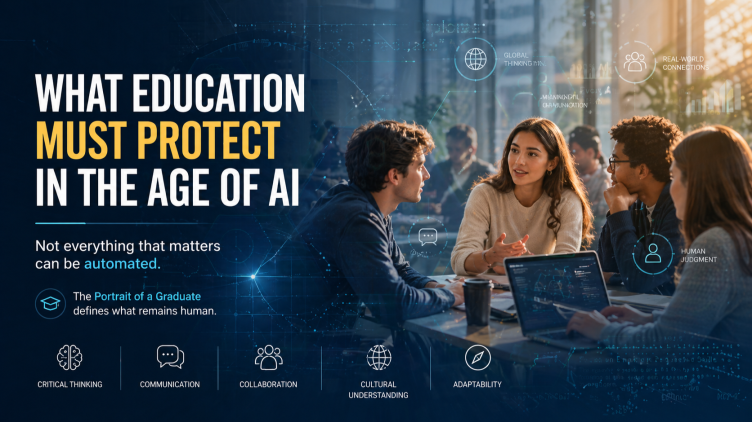
Why The Portrait Matters More, Not Less, In the Age of AI
By Dr. Marisol Marcin, Founder & CEO of Lenguas Club
Part 2 of the Portrait of a Graduate Series
______________________________________________________________________________
There is a question that few educators are asking loud enough, even though it sits at the center of every conversation about the future of schools: if artificial intelligence can write essays, solve equations, translate languages, and generate presentations, what part of education remains irreplaceable?
The class of 2026 is the first cohort of students who had access to generative AI throughout most of their university years. ChatGPT launched in November 2022, just as members of this class began their freshman year of college. Since then, they have used it to brainstorm ideas, summarize readings, draft papers, and practice for exams. In the United States, 86% of students reported using AI for school-related purposes during the 2024-25 school year. For many, AI has become as fundamental to their academic experience as a textbook or a laptop.
The question is not whether these students used AI. The question is what they learned to do because of it, despite it, or alongside it.
And that question leads directly to another one: if the Portrait of a Graduate was relevant before AI became ubiquitous, what does it mean now that the world has fundamentally changed?
______________________________________________________________________________
The Paradox AI Creates for Education
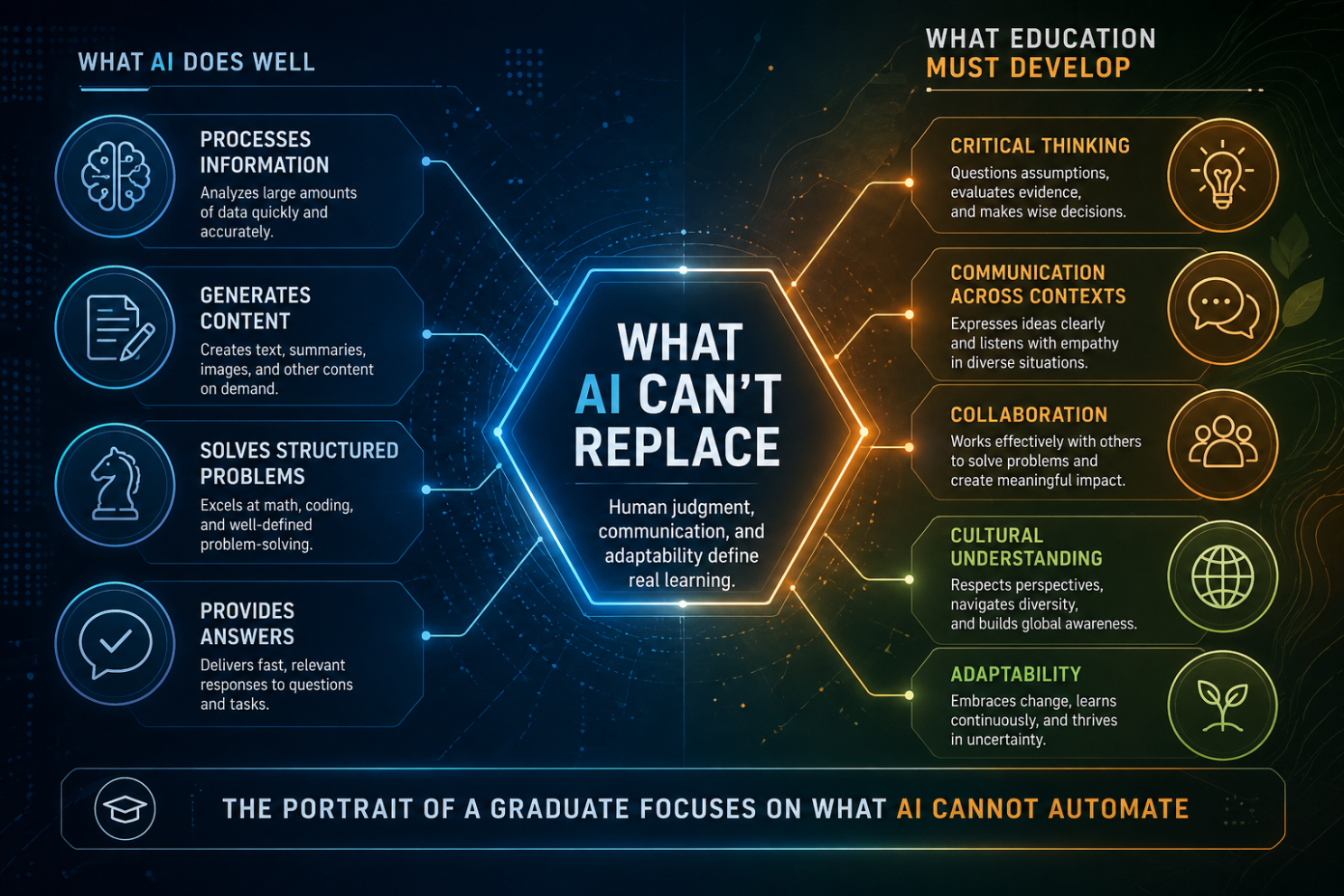
Artificial intelligence has automated precisely the kinds of tasks that schools have spent the last century teaching students to perform. It can retrieve information, summarize texts, generate grammatically correct prose, and solve structured problems faster and more accurately than most humans. If education’s primary goal was to help students access, retain, and reproduce knowledge, AI has made that goal easier to achieve than ever before.
But that was never actually the goal. It was just what we measured because it was measurable.
The Portrait of a Graduate movement emerged long before generative AI became a household tool. Twenty-six states adopted statewide frameworks defining what graduates should know and be able to do. Hundreds of districts created their own Portraits, each articulating the skills, dispositions, and capacities they wanted students to develop before receiving a diploma. And despite differences in geography, politics, and local values, the Portraits converged on the same essential attributes with striking consistency: critical thinking, effective communication, collaboration, creativity, global citizenship, and self-awareness.
Those attributes were chosen not because they sounded aspirational, but because communities, employers, and educators independently reached the same conclusion: academic content alone was no longer sufficient to prepare students for the world they would enter after graduation.
AI has not made that conclusion obsolete. It has made it urgent.
______________________________________________________________________________
What AI Can and Cannot Do
To understand why the Portrait matters more in the age of AI, it is necessary to be clear about what AI actually does well and what it struggles to do at all.
AI excels at pattern recognition. It can analyze vast amounts of data, identify trends, generate text based on learned structures, and provide answers to well-defined problems. For students, this means that AI can serve as an on-demand tutor, providing instant feedback on math practice, programming projects, and writing tasks. A 2026 Stanford review found that AI tools significantly improve student performance on these tasks while students have active access to the technology, with effect sizes strongest in mathematics and computer science. However, the research also shows that these gains often disappear when students are assessed without access to AI, highlighting that the technology accelerates skill development but does not replace the need for foundational understanding.
But AI does not think. It does not understand context in the way humans do. It cannot navigate ambiguity, make ethical judgments, or evaluate the reliability of the information it generates. It cannot empathize, build trust, or repair a misunderstanding in real time. It does not collaborate in any meaningful sense; it responds to prompts. It does not create in the sense of imagining something that does not yet exist; it remixes what already has.
When a student treats AI-generated outputs as ready-made answers, they risk bypassing the essential reasoning processes that education is designed to develop. Critical thinking does not emerge from access to correct answers. It emerges from the struggle to question premises, hold contradictions simultaneously, recognize when the entire framing of a problem is wrong, and choose which problem actually matters. Those capacities cannot be simulated. They must be built slowly, through years of reading, questioning, and mental model construction.
A 2025 report from the World Economic Forum emphasized that the skills AI struggles to replicate are precisely the ones that will define professional success in the coming decade. Judgment, empathy, creativity, critical thinking, and adaptability are not soft skills. They are the only skills that will consistently matter in a labor market where routine cognitive tasks can be automated.
And those are exactly the attributes that appear in every Portrait of a Graduate across the country.
______________________________________________________________________________
The ChatGPT Generation Enters the Workforce
The class of 2026 is graduating into a labor market that is still figuring out what to do with them. Employment growth for workers aged 22 to 25 in AI-exposed sectors has stagnated, showing a relative decline of 13% since 2022 as companies struggle to determine how AI tools should change hiring, onboarding, and role design.
The issue is not that AI is taking jobs. The issue is that AI is changing what jobs require. Entry-level positions that once served as training grounds for young professionals are being redesigned or eliminated as AI takes on tasks previously assigned to junior staff. At the same time, the roles that remain, and the new roles being created, demand capacities that cannot be automated: the ability to ask the right questions, interpret conflicting information, communicate clearly across contexts, work collaboratively with people who think differently, and continue learning long after formal education ends.
Students who rely on AI to complete assignments without developing those capacities will struggle. Students who used AI as a tool while building the habits of mind that AI cannot replicate will thrive. The difference between those two outcomes is not whether students had access to AI. It is whether their education prepared them to do the work that AI cannot.
That is where the Portrait of a Graduate becomes not just relevant but essential.
______________________________________________________________________________
Where The Portrait Comes to Life Across Disciplines
If the Portrait defines the attributes students need to develop, the next question is where those attributes are actually practiced, not just named on a poster or mentioned in a mission statement, but lived, daily, in ways that require students to think, communicate, collaborate, and adapt in real time.
The challenge for educators is to become intentional in developing learning experiences across all subject areas, which is where those attributes converge.
In Mathematics and Science
In mathematics, AI tools can improve student performance on practice problems and computational tasks while students have access to them. But those gains often diminish when students are assessed independently, without AI support. The irreplaceable part of math education is not the calculation. It is the moment when a student confronts a problem that does not fit a known pattern, tries multiple approaches, fails, revises their thinking, and builds the capacity to reason through uncertainty. AI can accelerate technical proficiency. It cannot replace the struggle that builds mathematical thinking.
In science, AI can generate hypotheses, simulate experiments, and analyze data patterns. But it cannot decide which question is worth asking in the first place, recognize when an unexpected result points to something more interesting than the original hypothesis, or navigate the ethical implications of a discovery. Those capacities emerge from authentic inquiry, not from generated outputs.
______________________________________________________________________________
In English, History, and Social Studies
In writing, AI can draft essays, suggest revisions, and correct grammar with near-perfect accuracy. A 2026 analysis of AI use in education found that while students with AI access produce more polished prose, their ability to think critically about argument structure, evidence selection, and rhetorical choices often declines when they rely on AI for drafting. The irreplaceable part of writing is not the final polish. It is the cognitive work of organizing ideas, choosing which evidence matters, and constructing an argument that persuades a reader who does not already agree.
In history and social studies, AI can summarize events, generate timelines, and provide quick access to factual information. But it cannot teach students to evaluate conflicting sources, recognize bias, question whose perspective is missing from a narrative, or understand that every historical account is an interpretation shaped by the person telling it. Those are the skills that matter when information is abundant, but judgment is rare.
In World Languages and Cultural Learning
Every real conversation in another language requires students to interpret tone, context, and intention. It requires them to negotiate meaning when understanding breaks down, to read emotional cues that are not stated explicitly, and to adjust their communication based on the context, the setting, and the purpose of the exchange. It requires collaboration in the truest sense: two people co-constructing understanding in real time. It requires creativity when the exact word or phrase does not exist, and adaptability when cultural norms shift the meaning of what was said.
AI can help with that work. It can provide grammar feedback, offer vocabulary suggestions, simulate conversational scenarios, and give students access to pronunciation practice whenever they need it. Tools like ChatGPT, Talkio AI, and other conversational AI platforms have made language practice more accessible than ever before. Students no longer need to wait for a tutor’s availability or travel abroad to hear a native speaker. They can practice daily, refine their skills, and receive immediate feedback on technical accuracy.
But AI cannot replace the moment when a student struggles to understand someone whose perspective is fundamentally different from their own and chooses to stay in the conversation anyway. It cannot replicate the experience of cultural negotiation, the discomfort of not knowing, or the connection that emerges when two people work together to bridge a gap in understanding that neither of them expected to encounter.
In Project-Based and Interdisciplinary Work
The most powerful learning environments for developing Portrait attributes are those that ask students to integrate knowledge across disciplines, work collaboratively on problems that do not have a single correct answer, and produce work that matters to someone beyond the classroom. AI can support that work by generating project ideas, providing research summaries, creating visualizations, and offering instant feedback on drafts. But it cannot replace the messy, human process of negotiating roles within a team, navigating
disagreement, deciding what to prioritize when time is limited, and revising a product based on feedback from real users.
Educators implementing AI-enhanced project-based learning have found that the most effective approaches position AI as a thinking partner rather than an answer generator. As documented in a 2025 study by Leading Educators and Valley New School, students who use AI to test ideas, explore alternatives, and receive formative feedback demonstrated higher levels of critical thinking and self-directed learning than students who use AI to complete tasks. Students at Valley New School used AI for “thought-partnering” to suggest subtopics and identify connections across subjects, and for practice-interviewing with AI taking on the persona of community experts before conducting real research interviews. The key difference was that AI enhanced students’ thinking process rather than replacing it.
The common thread across all of these examples is clear: AI can accelerate the development of technical skills, but it cannot replace the experiences that build judgment, adaptability, collaboration, and the capacity to think in situations where the answer is not already known.
______________________________________________________________________________
What It Means to Learn With AI, Not Against It
Districts that have begun integrating AI into their systems are learning the same lesson: AI is most valuable when it frees up time for the work that only humans can do.
A November 2025 analysis by the Center for Reinventing Public Education (CRPE) of early adopter districts found that the most effective strategies for AI integration were those that aligned AI tools with a coherent vision for teaching and learning. As the CRPE report “Districts and AI: Early Adopters Focus More on Students in 2025-26” documents, districts that treated AI as a productivity tool without rethinking what students were being asked to produce saw limited impact. In contrast, districts that used AI to support deeper learning, expand access to personalized feedback, and create space for authentic collaboration and creativity saw measurable gains in student engagement and skill development. The report emphasizes that “without a coherent vision or systemic strategy for learning, districts risk adopting AI in fragmented ways that amplify inequities and yield short-term gains rather than genuine transformation.”
Tools like Curriculum Genie and PowerSchool’s Connected Intelligence allow teachers to upload their district’s Portrait of a Graduate and generate lesson plans that embed those competencies into daily instruction. Rubrics generated by AI can assess Portrait attributes such as collaboration, critical thinking, and communication across subjects, making it easier for students to see how those skills transfer from math to English to science to world languages.
But the effectiveness of those tools depends entirely on whether teachers design tasks that require students to think, not just produce. If a task can be accomplished entirely by AI without requiring students to question, analyze, collaborate, or defend their reasoning, that task was probably not advancing the student in the first place. AI has exposed the parts of the curriculum that were always about compliance rather than competence.
______________________________________________________________________________
The Portrait as A Filter for What Matters
One of the most useful functions of the Portrait of a Graduate in the age of AI is that it serves as a filter. When districts are deciding which AI tools to adopt, which tasks to automate, and which experiences to protect, the Portrait provides clarity.
If a task can be completed by AI without requiring students to think critically, communicate with purpose, collaborate meaningfully, or demonstrate creativity, that task was probably not advancing the Portrait in the first place. AI has exposed the parts of the curriculum that were always about compliance rather than competence.
The Portrait asks a different question: what kind of person should walk out of our schools after twelve years of education? And that question does not change because technology changes. While the methodsand tools are destined to change, the attributes that define a prepared, thoughtful, capable graduate remain the same.
______________________________________________________________________________
Where Lenguas Club Fits in This Conversation
At Lenguas Club, we work with districts to design world language programs that align with their Portrait of a Graduate. That means building curricula around authentic conversation, not coverage, using virtual exchange to connect students across contexts and cultures, training teachers to facilitate the kinds of experiences where students practice the attributes the Portrait names: critical thinking, communication, collaboration, global citizenship, and self-awareness.
And it means integrating AI thoughtfully, not as a replacement for human interaction but as a tool that makes human interaction more accessible, more frequent, and more intentional.
Language education is one of the clearest examples of a discipline where the Portrait comes to life every day. But the principles apply across subjects. The question every district should be asking is not whether AI belongs in classrooms but rather how to use AI in ways that strengthen, rather than weaken, the development of the attributes their Portrait describes.
If your district has a Portrait of a Graduate but is still figuring out how AI should fit into that vision, we would be glad to talk with you. The work we do in world languages offers a model for what it looks like when every lesson, every assessment, and every student experience is designed with the Portrait in mind.
What does your Portrait of a Graduate say students should be able to do? And where are they actually practicing those skills every day, across every subject?
We would love to hear from you.
📞 607-682-2624
🌐 lenguasclub.com/contact/
#PortraitOfAGraduate #AIinEducation #FutureReadyStudents #K12Education #ProjectBasedLearning #CriticalThinking #ChatGPTGeneration
References
America Succeeds. (2026, March 20). Your state doesn’t have a Portrait of a Graduate. Here’s why this report still matters to you. https://americasucceeds.org/your-state-doesnt-have-a-portrait-of-a -graduate-heres-why-this-report-still-matters-to-you
Bogost, I.(2025, August 17). College students have already changed forever. The Atlantic. http s://www.theatlantic.com/technology/archive/2025/08/ai-college-class-of-2026/683901/
Center for Democracy & Technology.(2025, October). 85% ofteachers and 86% of students reported using AI in the 2024-25 school year. Multiple sources via Facebook, LinkedIn, and Campus Technology. https://www.facebook.com/CenDemTech/
Center for Reinventing Public Education (CRPE).(2025, November 12). Districts and AI: Early adopters focus more on students in 2025-26. https://crpe.org/districts-and-ai-early-adopters-focus more-on-students-in-2025-26/
Collaborative for Academic, Social, and Emotional Learning (CASEL).(2024, February 2). Portraits of a Graduate 2024. https://casel.org/portraits-of-a-graduate-2024/
Collaborative for Academic, Social, and Emotional Learning (CASEL). (2025, January 28). How can states prepare students for the future? The “Portrait of the Graduate” helps set the vision. https://casel.org/blog/how-can-states-prepare-students-for-the-future-the-portrait-of-the graduate-helps-set-the-vision/
Collaborative for Academic, Social, and Emotional Learning (CASEL). (2026, February 25). From vision to action: How Portraits of a Graduate align social and emotional competencies and future readiness. https://casel.org/links/from-vision-to-action-how-portraits-of-a-graduate-align-social-a nd-emotional-competencies-and-future-readiness
Dallas Federal Reserve Bank. (2026, January 5).Young workers’ employment drops in occupations with high AI exposure. https://www.dallasfed.org/research/economics/2026/0106
Ed Technology Specialists. (2025, July 7). Using AI tools to enhance project-based learning in K-12 classrooms. https://edtechnologyspecialists.com/using-ai-tools-to-enhance-project-based-learnin g-in-k-12-classrooms/
Edutopia.(2025, September 2). AI and your Portrait of a Graduate. https://www.edutopia.org/artic le/3-ways-combine-ai-portrait-graduate/
Engageli.(2025, July 14). 25 AI in education statistics to guide your learning strategy in 2026. http s://www.engageli.com/blog/ai-in-education-statistics
Faculty Focus. (2026, January 20). Designing the 2026 classroom: Emerging learning trends in an AI era. https://www.facultyfocus.com/articles/teaching-with-technology-articles/designing-the-20 26-classroom-emerging-learning-trends-in-an-ai-era/
Fortune.(2026, April 5). AI is cutting 16,000 U.S. jobs a month — and Gen Z is taking the biggest hit. https://fortune.com/2026/04/06/ai-tech-displacement-effect-gen-z-16000-jobs-per-month/
GettingSmart.(2025, May 27). How AI Impacts the Implementation of Portrait of a Graduate. https:// www.gettingsmart.com/2025/05/27/how-ai-impacts-implementation-of-portrait-of-a-graduate/
Harver.(2025, June 17). 7 human skills to hire for that can’t be replaced by AI. https://harver.com/bl og/hire-for-human-skills-ai-cant-replace/
Hernholm, S.(2025, October 15). 5 human skills AI can’t replace—and how schools can teach them. Forbes. https://www.forbes.com/sites/sarahhernholm/2025/10/15/5-human-skills-ai-cant-re
place—and-how-schools-can-teach-them/
MIT Sloan School of Management. (2025, June 9). These human capabilities complement AI’s shortcomings. https://mitsloan.mit.edu/ideas-made-to-matter/these-human-capabilities-complem ent-ais-shortcomings
Plagiarism Check. (2025, November 16). AI tools in academia in numbers: 2025 statistics. https:// plagiarismcheck.org/blog/ai-tools-in-academia-in-numbers-2025-statistics/
Scribbr.(2023, June 14).When was ChatGPT released? https://www.scribbr.com/frequently-asked-q uestions/when-was-chatgpt-released/
Stanford Accelerator for Learning. (2026).The evidence base on AI in K-12: A 2026 review. https://scale.stanford.edu/sites/default/files/The Evidence Base on AI in K-12 Report.pdf
Statista.(2024, October 13). Global student AI usage for schoolwork 2024. https://www.statista.co m/statistics/1498309/usage-of-ai-by-students-worldwide/
Stecher, D.(2026, January 15). AI can’t replace critical thinking. But we’re pretending it can. LinkedIn. https://www.linkedin.com/pulse/ai-cant-replace-critical-thinking-were-pretending-can daniel-stecher-lyfuf
Talkio AI.(2026, February 24).Best AI-language speaking practice apps in 2026. https://www.talki o.ai/blog/best-ai-language-speaking-practice-apps-in-2026
The Economist.(2025, November 28). America’s class of 2026 will be the first members of the ChatGPT generation to graduate. Instagram. https://www.instagram.com/p/DRnAKEVFYni/
Tutorflow.(2026, February 22). How AI is transforming education in 2026: Beyond the hype to real impact. https://tutorflow.io/blog/how-ai-is-transforming-education-2026
World Economic Forum. (2026, January 13). The future of jobs: 6 decision-makers on AI and talent strategies. https://www.weforum.org/stories/2026/01/how-ai-will-affect-work-in-different-industri es/
World Economic Forum. (2026, January 21). Invest in the workforce for the AI age: A blueprint for scale, skills, and learning. https://www.weforum.org/stories/2026/01/ai-roadmap-transforming/
ZINFI Technologies. (2025, February 12). The benefits of interdisciplinary AI education for the future workforce. https://www.zinfi.com/blog/ai-education-benefits-future-workforce/



4 Comments
thanhtrahan748
mayo 5, 2026 - 8:40 pmThis is the perfect web site for anybody who hopes to find out about this
topic. You realize so much its almost hard to argue with you (not that I personally would want
to…HaHa). You certainly put a new spin on a subject which has been discussed for ages.
Excellent stuff, just wonderful!
Marisol M
mayo 15, 2026 - 2:32 pmThank you so much for taking the time to read and for sharing such a thoughtful comment. I’m glad the article offered a different angle on a topic that has been discussed for so long. My goal was precisely to reopen the conversation around the human side of learning in an age of AI, so it means a lot to know that this perspective resonated with you. If you ever feel like sharing how this topic shows up in your own teaching or learning context, I’d love to hear more.
https://www.cucumber7.com/
mayo 13, 2026 - 10:35 amI think this is one of the most vital information for me.
And i am glad reading your article. But want to remark on few general things, The site style is great, the articles is really great : D.
Good job, cheers
My webpage; https://www.cucumber7.com/
Marisol M
mayo 15, 2026 - 2:40 pmThank you so much for your kind words and for taking the time to share your impressions. I’m really glad to hear that you found the article meaningful and that the overall style of the site works well for you. The intention behind these pieces is to offer useful, thoughtful reflections for teachers and learners who care about language and human connection in the age of AI.
If there are specific topics you’d like to see explored in future articles, I’d be very happy to hear your suggestions.